 SaveFaste

.png)
Introduction
PDF is the standard for sharing documents that preserve layout and formatting across devices. But when you need to edit text, update tables, or repurpose content, a static PDF becomes a hurdle. Converting a PDF to an editable Microsoft Word document (DOCX) is the common solution — and the best part is, you don’t always need to install software on your computer. This guide explains multiple reliable methods to convert PDF to Word without installing any programs, whether you are on Windows, macOS, Linux, iPhone, or Android.
We’ll cover free web-based tools (including Savefaste), cloud services like Google Docs and Microsoft Word Online, and how to deal with tricky cases (scanned PDFs, images, tables, and complex layout). By the end of this article you’ll know the step-by-step workflows and practical tips to keep formatting intact and minimize cleanup.
Why Convert PDF to Word?
There are several reasons you might want to convert a PDF to Word:
- Edit text easily: Word lets you change wording, correct typos, and reformat without special tools.
- Reuse content: Copy paragraphs, headings, and images into new documents or presentations.
- Preserve layout when possible: Modern converters attempt to keep columns, images and tables aligned.
- Accessibility: Make content accessible for screen readers or other assistive technologies by exporting to a clean Word document.
- Offline editing: Convert once online, then download and work offline in Word.
Quick Overview: Methods
We’ll walk through three main approaches — choose the one that matches your file and needs:
- Google Docs: Free, cloud-based, great for text-based PDFs and basic layouts.
- Microsoft Word Online / Word desktop: Often preserves layout better for complex documents.
- Savefaste Online Converter: Built specifically for PDF conversions, with options for OCR, batch conversion and format control.
Method 1 — Convert PDF Using Google Docs
Google Docs is one of the easiest free ways to convert a PDF to a Word document without installing any software. It’s especially reliable for PDFs that have selectable text (not scanned images).
Step-by-step
- Open Google Drive and sign in with your Google account.
- Click New → File upload and upload the PDF file.
- Right-click the uploaded file → Open with → Google Docs. Google Docs will open the PDF and convert it to an editable document.
- From the Google Docs menu: File → Download → Microsoft Word (.docx).
Notes: Google Docs conversion works best when PDF text is selectable. If your PDF is scanned (image-based), use an OCR-capable tool (see OCR section below).
Method 2 — Convert Using Microsoft Word Online / Word Desktop
Microsoft Word (desktop) can open PDFs and save them as DOCX. Word Online also provides conversion, though the desktop app sometimes preserves formatting better.
Step-by-step (Word Online)
- Go to Office.com and sign in with your Microsoft account.
- Open Word Online and choose Upload and open, then select the PDF.
- Word will convert the PDF to an editable Word document. Review the content and then File → Save As → Download a Copy to get the DOCX file.
Step-by-step (Word Desktop)
- Open Microsoft Word (desktop) → File → Open → select your PDF file.
- Word automatically converts it and opens a new editable document. Check layout and then File → Save As → Word Document (.docx).
Tips: Word’s conversion is often superior for documents with tables, complex spacing, and lists. However, some manual tweaks may be required for multi-column layouts or advanced formatting.
Method 3 — Convert Using Savefaste Online Converter
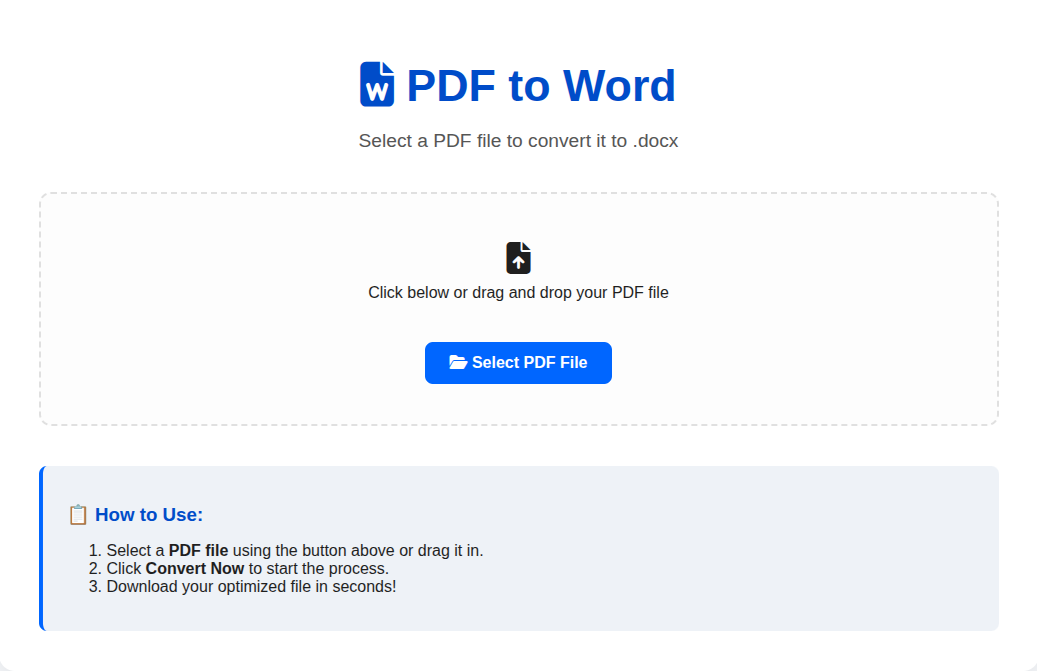
Savefaste provides a purpose-built web converter for PDF to Word that balances speed and layout accuracy. It supports batch conversion, OCR for scanned pages, and keeps images/tables in place where possible.
How to convert on Savefaste
- Open https://savefaste.com/pdf-to-word.
- Upload your PDF (drag & drop or click upload).
- Choose options: Standard conversion or OCR (for scanned PDFs).
- Start conversion and wait for it to finish. Download the DOCX file when ready via the provided button or your Savefaste Download Center.
Handling Images, Tables and Complex Layouts
Preserving layout is the trickiest part. Here’s what you can do to maximize accuracy:
- Tables: Choose converters that explicitly support table detection (Savefaste and Word often do). After conversion, check table cell alignment and column widths.
- Images: Most converters extract images as separate files or embed them in the DOCX. Expect slight position shifts; reposition images manually if needed.
- Multi-column text: Converters may linearize columns into single-column flows. For complex magazine-style layouts, manual reflow is often required.
- Fonts: If your original uses uncommon fonts, Word will substitute. Embed fonts in your final DOCX if necessary (Word desktop: File → Options → Save → Embed fonts).
OCR: Converting Scanned PDFs to Editable Word
Scanned PDFs are images of text and need OCR (Optical Character Recognition) to extract editable text. Use OCR-enabled tools:
- Savefaste OCR: Built-in OCR option during conversion.
- Google Drive + Google Docs: Upload scanned PDF → Open with Google Docs — Google will run OCR automatically (accuracy depends on image quality).
- Online OCR services: Use reputable OCR services that allow export to DOCX.
OCR Tips: Ensure your scanned pages have good resolution (300 DPI recommended), clear contrast, and minimal skew for best results.
Tips for Better Conversion Accuracy
- Start with a high-quality PDF: If you can, regenerate the PDF from the original source at a higher resolution.
- Use OCR for scans: Don’t expect selectable text from image-based PDFs without OCR.
- Split large PDFs: Convert large documents in smaller chunks to reduce errors and speed up processing.
- Check fonts and styles: Post-conversion, verify headings, bullets and lists — apply Word styles to standardize formatting.
- Use Savefaste batch tools: For multiple files, Savefaste supports batch conversions and queue management.
Privacy & Security — What to Expect
When you use online converters, file privacy matters. Good practices:
- Check the service’s privacy policy — Savefaste deletes files after a short retention period.
- Avoid uploading sensitive documents to untrusted services. For highly confidential files, prefer local software with offline conversion.
- Use a secure connection (HTTPS) and, if available, enable password-protected uploads or one-time download links.
Troubleshooting Common Issues
Missing text or garbled characters
This often indicates the PDF used embedded or uncommon fonts. Try converting with a different tool (Word vs Google Docs) or regenerate the PDF with embedded fonts replaced.
Tables broken or misaligned
Export only the table pages and convert them separately; then copy-paste the cleaned table into your main DOCX file.
Huge file size after conversion
Images embedded at high resolution increase DOCX size. Compress images inside Word (Picture Format → Compress Pictures) or use Savefaste’s compress tool before conversion.
FAQ
Is it safe to convert PDFs online?
Yes — if you use trusted services with HTTPS and clear privacy policies (like Savefaste). For highly confidential documents, prefer offline tools.
Will conversion keep the exact layout?
Most converters aim to preserve layout, but exact fidelity depends on PDF complexity. Expect some manual adjustments for advanced layouts.
Can I convert scanned PDF to Word for free?
Yes — many services offer free OCR for limited pages. Savefaste and Google Docs provide OCR, though heavy usage might require a paid plan.
What formats can I export to besides DOCX?
Common options include RTF, TXT, and sometimes HTML or ODT. Savefaste supports multiple export targets based on user needs.
Conclusion
Converting PDF to Word without installing software is straightforward using cloud tools. For most users, Google Docs and Microsoft Word Online cover common needs. For higher accuracy, batch conversions, OCR and table detection, Savefaste's online converter is optimized to deliver fast, reliable results. Always verify converted documents for layout and formatting, and follow privacy best practices when uploading files online.
Ready to convert? Use our fast tool: